

What the PED is
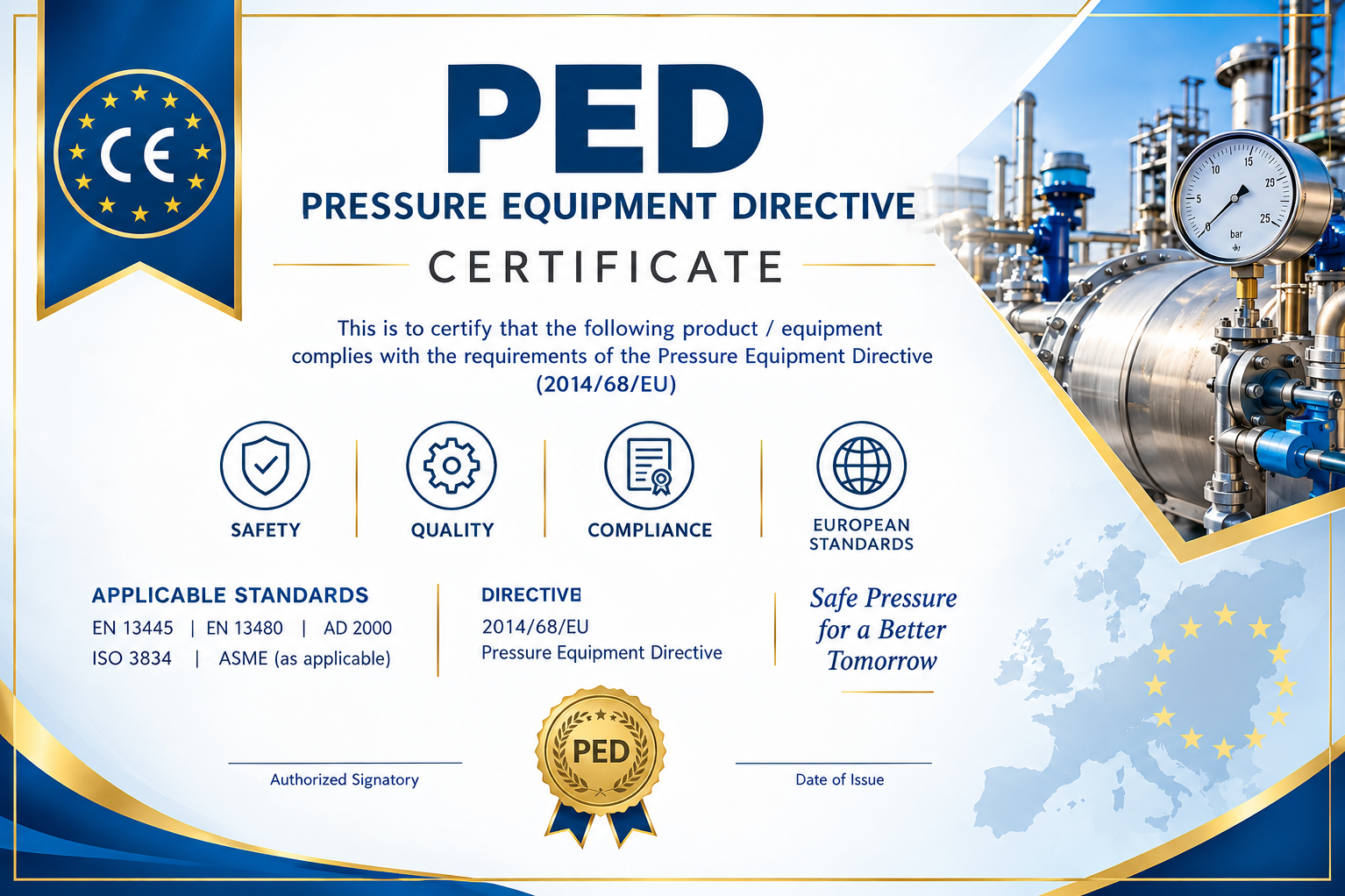
The Pressure Equipment Directive, 2014/68/EU, is the EU law that any pressure equipment must satisfy before it can be sold or put into service anywhere in the European Economic Area. It applies to vessels, piping, safety accessories and pressure accessories with a What the PED ismaximum allowable pressure above 0.5 bar gauge. Meet it and you affix the CE mark; fail to and the product cannot legally be placed on the EU market, whatever its ASME stamp or ISO certificate says.
PED is not a certification scheme in the way API or IATF are. It is a legal obligation on the manufacturer, who signs a declaration taking full responsibility. A Notified Body is involved only to the degree the risk of the equipment demands, which can range from not at all to supervising every weld.
It does not cover everything with pressure in it. Transportable gas cylinders, simple pressure vessels under 2014/29/EU, pipelines for transport of fluids to or from installations, nuclear equipment, well-control equipment and road vehicle components are all excluded. The first job on any enquiry is confirming the product is inside the scope at all.
Classification decides everything
Everything that follows in PED depends on one step: classifying the equipment. Get it wrong and you either over-spend on a Notified Body you did not need or ship illegal product.
Three inputs set the category. First, the type of equipment: a vessel, piping, a fired or electrically heated unit with a risk of overheating, or a safety accessory. Second, the fluid group: Group 1 covers fluids classified as hazardous under the CLP Regulation (flammable, toxic, oxidising and so on); Group 2 covers everything else, including steam, water, air and nitrogen. Third, the fluid state, gas or liquid, where a liquid with a vapour pressure above 0.5 bar over atmospheric at the maximum allowable temperature is treated as a gas.
With those settled, you take the maximum allowable pressure PS and the volume V for vessels, or the nominal size DN for piping, and read the category off the nine conformity assessment charts in Annex II. The result is one of four categories, I to IV, rising with hazard. Below the bottom line of the chart, the equipment is designed to Sound Engineering Practice (SEP): it must still be safe and traceable to the manufacturer, but it gets no CE mark and no Notified Body.
Two things catch people. Safety accessories such as relief valves are automatically Category IV unless they are made for specific lower-category equipment. And an assembly, several pieces of pressure equipment put together by one manufacturer into an integrated whole, takes the category of its highest-category component and must be assessed as an assembly, not as a collection of parts.
The modules and the Notified Body
The category sets which conformity assessment modules you may use, and the modules set how much of a Notified Body you buy.
For Category I the manufacturer works alone under Module A: internal production control, self-declaration, no outside body. The CE mark carries no Notified Body number.
From Category II upward a Notified Body must be involved, and the manufacturer chooses between two routes. The product route has the body examine the equipment itself: Module A2 or C2 for random checks on Category II, Module F or G for unit verification of every item at Category III and IV, where G means the body witnesses design review, material checks, welding, NDT and the final test on each individual vessel. The system route has the body approve and surveil your quality system instead: Module D, E or H, with H1 adding a design examination for Category IV. Module B, EU-type examination, pairs with D, E, F or C2 when you make a series of identical units.
The choice is commercial as much as technical. A fabricator building one large Category IV column a year takes Module G and pays per job. A valve maker shipping thousands of Category III units takes B plus D and pays for an annual system audit. Both are legal; one of them is cheaper for you.
The Notified Body must be notified for PED by an EU member state and listed in the NANDO database under 2014/68/EU. A body accredited only for ISO 9001 cannot do this work, and a non-EU body cannot unless it holds EU notification through a European legal entity.
What you must prove: the Essential Safety Requirements
Annex I of the directive lists the Essential Safety Requirements, the ESRs. They are written as outcomes, not methods. You can meet them by designing to a harmonised standard such as EN 13445 for vessels, EN 13480 for piping or EN 12952 for water-tube boilers, which gives a presumption of conformity, or by another route such as ASME VIII, in which case you must demonstrate equivalence clause by clause and the Notified Body will want to see that demonstration.
The requirements that generate most of the evidence are these.
- Design must include a documented hazard analysis and design calculations or experimental design validation, with adequate safety factors, for all reasonably foreseeable loads: pressure, temperature, cycling, corrosion, external loads, decomposition of unstable fluids.
- Materials for pressure-bearing parts must be suitable, ductile and tough, with a European Approval for Materials, a harmonised standard material, or a Particular Material Appraisal by the Notified Body. Inspection certificates to EN 10204 type 3.1 are the floor for Category II and above; 3.2 is needed when the material maker has no certified quality system.
- Permanent joining, meaning welding and brazing, must be done by qualified personnel using qualified procedures. For Category II and above those qualifications must be approved by a Notified Body or a Recognised Third-Party Organisation, not just your own welding engineer.
- Non-destructive testing personnel for Category III and IV must be approved by a Recognised Third-Party Organisation, so an in-house Level 2 to your own written practice is not enough.
- Final assessment covers a visual and documentary inspection, a hydrostatic proof test at a pressure not lower than 1.43 times PS for standard cases, and a check of safety devices.
- Marking and instructions must give PS, TS, volume, fluid group, serial number, year, CE mark, and operating instructions in the language of the destination country.
The paperwork
Four documents close the loop, and the manufacturer, not the Notified Body, owns all of them.
The technical documentation is the file that proves conformity: general description, design and manufacturing drawings, calculations, the list of standards applied in full or in part and how any gaps were handled, material certificates, welding and NDT qualifications and records, test reports, and the Notified Body's certificates where a module required them. It must be kept for ten years after the last unit is placed on the market and produced on demand to any EU market surveillance authority.
The EU Declaration of Conformity is a signed statement, in the format of Annex IV, naming the equipment, the directive, the harmonised standards and the Notified Body with its number where one was used. It travels with the equipment or is available on request. For an assembly, one declaration covers the whole.
The CE mark goes on the equipment, legibly and indelibly, followed by the Notified Body's four-digit identification number for Category II and above. No number for Category I. No CE mark at all for SEP.
The operating instructions in the user's language, with the safety-relevant data from the design, are a legal requirement, not a courtesy.
A manufacturer outside the EU needs an authorised representative or relies on the importer, who carries legal duties of their own under the directive. The technical file still has to exist and be reachable from inside the Union.
Where manufacturers fail
- Wrong classification. Fluid group guessed rather than taken from the CLP classification, or a liquid treated as a liquid when its vapour pressure makes it a gas. Everything downstream is then built to the wrong category.
- Material certificates that do not match the design. A 3.1 certificate from a mill with no certified system where 3.2 was needed, or a grade with no European approval and no Particular Material Appraisal.
- Welder and procedure qualifications to the wrong body. Qualifications witnessed by a customer inspector or the company's own welding engineer are fine for Category I and worthless above it.
- NDT by unapproved personnel. Category III vessels radiographed by an in-house technician with no Recognised Third-Party Organisation approval.
- ASME design with no equivalence case. The calculation is sound, but nobody has shown the Notified Body how each ESR is met, so the design review stalls.
- Technical file assembled after shipment. The file is a reconstruction, with gaps that market surveillance will find first.
Preparation is a classification check on every product line, a gap review of the ESRs against your current design and fabrication controls, and getting welding and NDT qualifications re-done under a Recognised Third-Party Organisation before the first Category II order arrives, not during it.
The takeaway
PED is a law you comply with, not a badge you earn. The Notified Body checks; the manufacturer declares and carries the liability. Treat the category as the first engineering decision on any EU pressure job, build the technical file as the job runs, and qualify your welders and NDT people under a recognised body before you quote. Everything else is paperwork that follows from those three.