

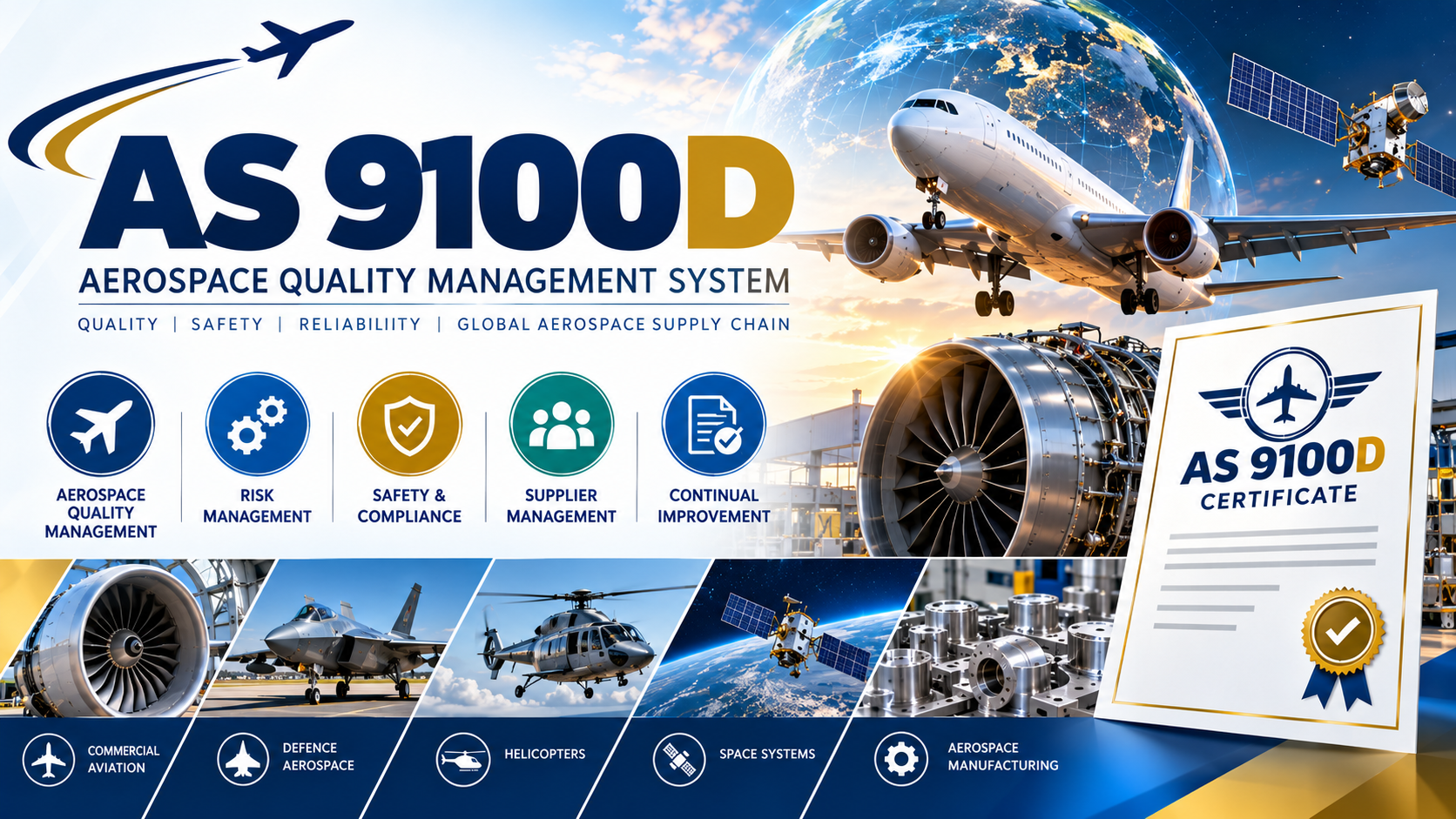
AS9100 is ISO 9001 with the aerospace industry's scar tissue written in. Open the standard and the ISO text is in plain type; everything the International Aerospace Quality Group added after an aircraft, a satellite or a missile programme went wrong is in bold italics. Read only the bold italics and you have the whole story of what aerospace buyers are afraid of.
Revision D, published in September 2016 on the ISO 9001:2015 framework, is the current edition and the one every aerospace supplier is certified to today. Its replacement, to be renumbered IA9100 under IAQG's publishing deal with SAE, has slipped twice while IAQG waits on the ISO 9001 revision, and certification bodies are now quoting late 2026 or early 2027 for release, followed by a single transition window for all three standards in the family. So the D revision has at least two more years of life, and anything built to it now will carry over with a delta rather than a rebuild.
If you supply machined parts, forgings, fasteners, heat treatment or NDT to anyone whose customer is Boeing, Airbus, HAL, Safran, Rolls-Royce or ISRO, you will be asked for it, and in most of those supply chains you cannot bid without it.
What aerospace adds
Each of these is a clause ISO 9001 does not have, and each exists because of something that happened.
Product safety (clause 8.1.3). You must plan and control the product's safety through its whole life, which means identifying the characteristics whose failure would hurt someone and controlling them harder than the rest. In practice: key characteristics flagged on drawings, flowed to the shop floor, and recorded individually.
Counterfeit part prevention (8.1.4). You must have a process to stop counterfeit or suspect parts entering your product, with trained people, approved sources and verification of anything bought outside the manufacturer's authorised chain. This clause came from the fake electronic components found in US defence hardware a decade ago and now reaches raw-material certificates too.
Human factors (10.2). Root-cause analysis must consider whether fatigue, distraction, communication or workplace design caused the error, not just whether the operator 'was retrained'. Aviation maintenance learned this the hard way; the standard imports it.
Configuration management (8.1.2). You must know exactly which revision of which drawing, specification and process built which serial number, and be able to prove it years later. Aerospace parts outlive the people who made them.
Operational risk management (8.1.1). Risk assessment at the level of the individual order and process, not only the business.
Special processes (8.5.1.2). Heat treatment, plating, welding, NDT and the rest must be validated, with qualified people and equipment, and the customer may require Nadcap accreditation on top of AS9100 for each of them. For a heat-treatment supplier this is the clause that decides the business.
Foreign object prevention (8.5.4). A system for keeping tools, swarf, hardware and debris out of the product, with controls that match the risk.
First article inspection (8.5.1.3). A complete verification of the first production part against every drawing and specification requirement, to AS9102, repeated whenever the process changes.
Release and delivery (8.6). Certificates of conformance that state exactly what was done and by whom, with records retained for the customer's required life, which for airframe parts can be the life of the aircraft.
How certification works
AS9100 certification is tighter than ISO 9001 certification in three ways that matter.
The certification body must be accredited for aerospace and its auditors must be authenticated aerospace auditors registered with IAQG; a general ISO 9001 registrar cannot issue the certificate. The audit itself follows AS9101, which prescribes how the auditor must work: process-based, following the product through the organisation, with a Process Effectiveness Assessment Report for each process audited. And the result goes into OASIS, the IAQG's online database, where every certified organisation's status, scope, and certification body is visible to any aerospace buyer who logs in. A customer checks OASIS before they ring you.
The cycle is three years: a two-stage initial audit, then surveillance audits each year, then recertification. Nonconformities are graded major or minor to AS9101's definitions, and a major is not negotiable: it is the absence or total breakdown of a process, or a condition that could ship nonconforming product, and the certificate is not issued or is suspended until it is closed with verified evidence. Nonconformities also go into OASIS, so a bad year is visible.
Nadcap sits alongside, not inside. It is a separate accreditation for each special process, run by PRI, with its own checklists and auditors drawn from the primes themselves. AS9100 says your special processes must be controlled; the customer's quality flow-downs say by whom, and for heat treatment, chemical processing, NDT, welding and coatings the answer is usually Nadcap. Budget for both if you run any of those.
What it costs a small shop
The certificate fee is the small part. The real cost is the discipline the bold italics demand on a shop that has been running comfortably on ISO 9001.
Traceability becomes serial-number deep. Every part, every heat, every operation, every operator, every instrument, retrievable on demand and kept for decades. Shops that manage traceability on a batch card and a shared drive find that this alone forces a change of system.
Key characteristics get measured and recorded one by one, not sampled. If the drawing flags a fillet radius or a case depth as a KC, you record it for each part or run SPC to AS9103 and keep the charts.
First article inspection to AS9102 takes a full day of an engineer's time per new part, and must be redone on any change to material, process, tooling, location or a lapse in production of two years. Quoting new aerospace work without pricing the FAI is the most common way small shops lose money on their first order.
Supplier control reaches your sub-tiers. Your heat treater, plater and NDT house must meet the customer's flow-downs, which usually means Nadcap, and you carry the finding if they do not.
Customer flow-downs multiply. Each prime has its own supplier quality requirements document layered on AS9100; Boeing, Airbus and HAL do not read the same way, and the contract review clause expects you to have read all of them.
And the trap that catches people later: a counterfeit-parts process that exists on paper but has never actually stopped a suspect raw material certificate, and a human-factors root cause that is 'operator retrained' with the words human factors written above it. Aerospace auditors have seen both and grade them as majors.
Who should go for it
A shop with a named aerospace or defence customer asking for it, or with a credible route to one through a Tier 1 or a HAL or DRDO package. For that shop the certificate is table stakes, and with IA9100 still a year or more away there is no reason to wait for the new edition; build to D now and take the delta later.
A shop chasing it for the prestige, with no aerospace customer in sight, will spend a year and a sizeable sum building traceability and FAI discipline nobody will pay for. Automotive and general engineering customers do not reward it. If that is you, do IATF 16949 or stay with ISO 9001 and spend the money on the equipment.
One honest test: can you name the prime at the top of the chain for your first aerospace order, and have you read that prime's supplier quality requirements? If yes to both, start. If no to either, you are not ready to decide.
Contact Now - 9054219825