

A purchase order arrives with a line that says 'RoHS certificate required with first supply'. The sales engineer rings a test lab, the lab tests one sample for lead, cadmium, mercury and chromium, a two-page report comes back with a green tick, and it goes to the customer under a cover letter headed RoHS Certificate. Everyone is satisfied until a buyer at the customer's customer asks what that report actually certifies, and the honest answer is: one sample, four substances, on one day.
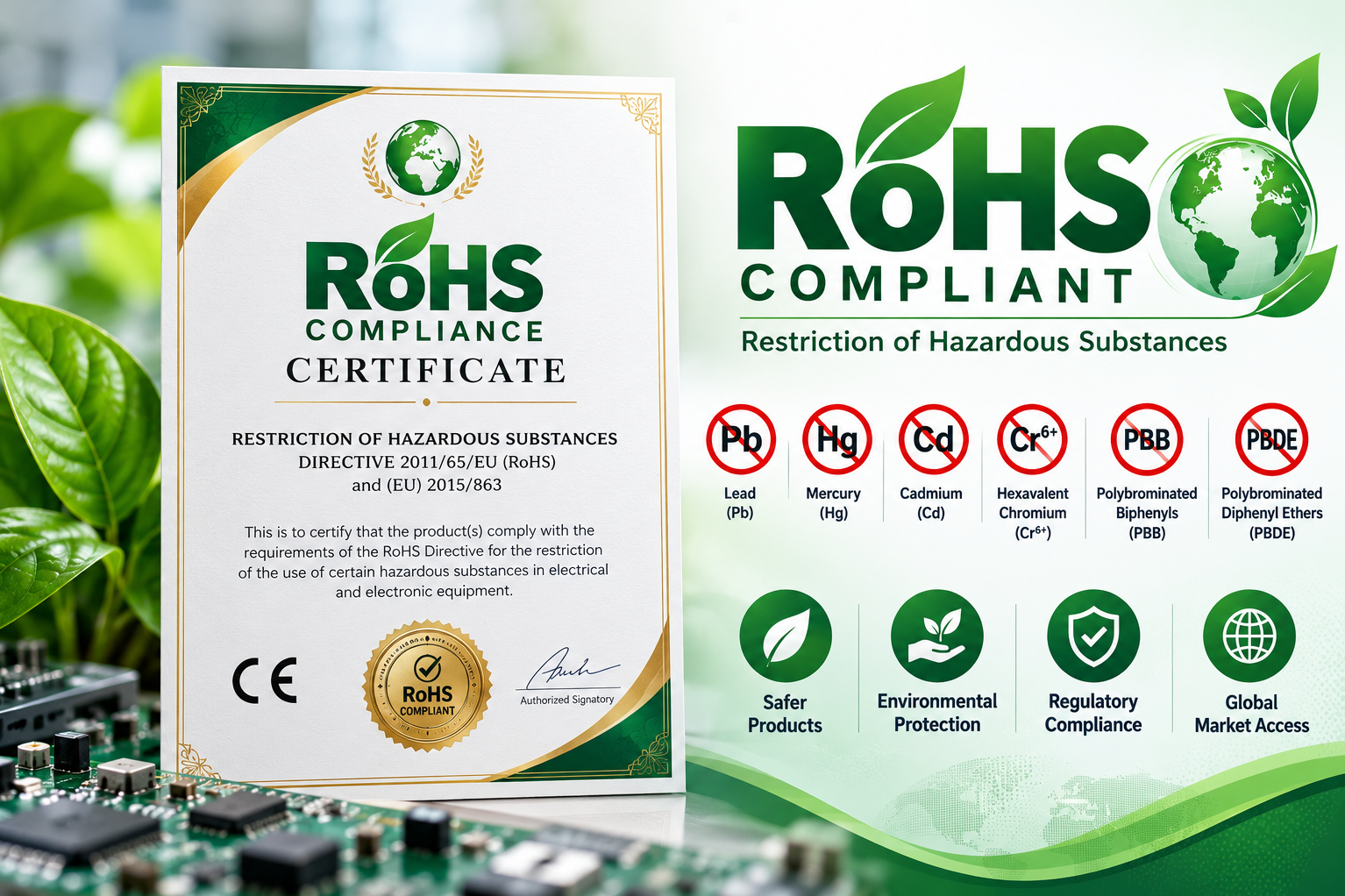
There is no such thing as a RoHS certificate. RoHS, the EU directive 2011/65/EU on the restriction of hazardous substances in electrical and electronic equipment, is a self-declaration regime. No body certifies a product RoHS compliant; the manufacturer who puts the finished equipment on the EU market declares it, signs an EU Declaration of Conformity, affixes the CE mark and keeps a technical file that proves the declaration. A lab report is one piece of evidence in that file. A supplier's letter is another. Neither is a certificate, and a customer who knows the directive will read anything called one with suspicion.
What the customer needs from a component supplier is not a certificate. It is evidence they can put in their own file. That is a different and more useful thing to produce.
The ten substances, and where they hide in a metal part
RoHS restricts ten substances: lead, mercury, cadmium, hexavalent chromium, the two brominated flame retardants PBB and PBDE, and since 2019 four phthalate plasticisers, DEHP, BBP, DBP and DIBP. The limit is 0.1 percent by weight for each, except cadmium at 0.01 percent. The list has not changed in 2026; the regulatory activity this year is in the exemptions, where the Commission adopted new delegated directives in late 2025 covering metal alloys, glass and ceramics, and high-temperature solders, with member states transposing by mid-2026.
The limit applies per homogeneous material, not per part. A homogeneous material is one that cannot be mechanically separated into different materials: the steel of a shaft is one, the zinc plating on it is a second, the chromate passivation on the plating is a third, the plastic cap is a fourth. Each must individually be under the limit. A plated steel component is compliant only if the steel, the plating and the passivation each pass.
For a machining or heat-treatment shop the exposure is specific and usually in the surface treatment rather than the base metal.
- Hexavalent chromium in yellow and olive chromate passivations on zinc and cadmium plating, and in some chrome conversion coatings on aluminium. The trivalent alternatives exist and have been standard for two decades, but a plater who was never asked may still be running the old bath.
- Cadmium in cadmium plating on fasteners and in some silver-brazing alloys. The 0.01 percent limit means essentially none.
- Lead in free-cutting steels, leaded brasses and bronzes, and in solders. Steel with up to 0.35 percent lead, aluminium with up to 0.4 percent and copper alloys with up to 4 percent are covered by the long-standing Annex III exemptions 6a, 6b and 6c, which is why EN 1A leaded free-cutting steel is still permitted; those exemptions are among the ones being revised, so check the current expiry and scope before relying on them.
- Phthalates in any plastic, rubber or PVC component, cable sheathing, grommet, seal or coating supplied with the part.
Mercury, the brominated flame retardants and the rest rarely appear in a machined metal component, but the declaration still has to say so.
Who the requirement reaches
RoHS applies to electrical and electronic equipment: anything dependent on electric current or electromagnetic fields to work, across eleven categories from household appliances and IT equipment to tools, toys, medical devices, monitoring instruments and, since the open-scope date in 2019, everything else not specifically excluded. Vehicles, large fixed installations, military equipment and some industrial tools are out of scope, but the components that go into them often also go into something that is in scope, and the customer will not maintain two part numbers.
The legal obligation sits with the manufacturer, importer or distributor who places the finished equipment on the EU market. A component supplier in Rajkot has no direct obligation under the directive. The requirement reaches you through the contract: the equipment maker cannot sign their declaration without evidence for every material in the product, so they push the evidence requirement down the chain, usually as a clause on the purchase order, a supplier declaration form, or a line in the quality agreement. That contractual requirement is the one you have to meet, and the customer sets its form.
India has its own version. The E-Waste (Management) Rules, 2022, carry a RoHS provision under which producers of EEE placed on the Indian market must ensure the same six original substances, lead, mercury, cadmium, hexavalent chromium, PBB and PBDE, stay under the same limits, with self-declaration to the CPCB and the same per-homogeneous-material logic. Indian EEE producers are therefore asking their component suppliers for the same evidence, and a supplier set up for the EU requirement is already set up for the Indian one.
What the evidence has to contain
The directive points to a harmonised standard, EN IEC 63000, for how a manufacturer builds the technical documentation. It does not demand testing. It demands that for every material in the product the manufacturer holds evidence, proportionate to the risk, that the substances are under the limit, and it accepts three kinds of evidence in combination: supplier declarations, material declarations, and analytical test results. The customer's requirement on you is a mirror of this. What they need from a component supplier is some mix of the following.
A supplier declaration of conformity. A signed statement on your letterhead, for a named part number or part family and a named drawing revision, that the part complies with Directive 2011/65/EU as amended by 2015/863, listing all ten substances, stating any Annex III exemption relied on by number (for leaded free-cutting steel, 6a), naming the person responsible, and dated. Many customers supply their own form; use it. A generic 'we are RoHS compliant' letter with no part number, no revision and no exemption statement is the one most often sent back.
Material declarations for each homogeneous material. The mill certificate for the steel showing lead content, the plater's declaration that the bath is cadmium-free and the passivation trivalent, the rubber or plastic supplier's declaration on phthalates. You are assembling your sub-suppliers' evidence into yours, and the chain is only as strong as the weakest declaration in it.
Test reports where the risk justifies them. An XRF screening is fast and cheap and will show lead, cadmium, mercury and total chromium in a plating in minutes, but it cannot distinguish hexavalent from trivalent chromium and cannot see phthalates at all. For those, wet chemistry at an accredited lab under IEC 62321 is the method: a spot test or extraction for Cr(VI), and GC-MS for phthalates. Test the surface treatment, not the whole part, because the per-material rule means a bulk result on a plated part is meaningless. Retest when the plater, the passivation chemistry, the steel grade or the rubber compound changes, not on a calendar.
Traceability from the declaration to the parts shipped. The declaration is for a part as defined by a drawing revision and a bill of materials; the customer will want to connect it to a lot. A change in sub-supplier or material that is not notified breaks that link, and is the most common way a compliant supplier becomes a non-compliant one without knowing.
The CE mark and the EU Declaration of Conformity belong to the finished equipment and its manufacturer. A component supplier does not CE-mark a machined part for RoHS and should not claim to.
Why declarations get rejected
- No part number or revision. A company-level letter cannot be tied to a part, so the customer cannot file it against anything.
- Six substances instead of ten. Declarations written before 2019 and never updated still omit the phthalates. The customer's checklist has ten lines.
- No exemption cited. A leaded free-cutting steel part declared simply 'compliant' is either wrong or relying on exemption 6a without saying so. Say so, by number.
- A test report on the wrong thing. XRF on the bulk of a plated part, or a Cr(VI) result from XRF, which cannot measure it. The customer's engineer will know.
- A test report with no sub-supplier declarations behind it. One sample proves one sample. The declarations prove the process.
- An expired or unsigned document. Customers put an age limit on declarations, commonly one to two years; an undated letter has no age and gets treated as expired.
- Not notifying a change. The plater changed, the passivation went from trivalent to a cheaper yellow chromate, nobody told the customer, and the declaration on file is now false.
Most of these are clerical, and all of them delay a first shipment or trigger a supplier quality incident on a part that was, in fact, compliant.
What to put in place
A shop that supplies parts into electrical equipment needs four things, none of them expensive.
A material register: every steel grade, alloy, plating, passivation, paint, rubber and plastic you use, with the sub-supplier, the declaration on file and its date. Build it once, and update it when a material or supplier changes.
A declaration template, per part family, that names all ten substances, cites exemptions by number, carries a drawing revision and a date, and is signed by someone who has seen the register. Reissue it when the register changes or the customer's age limit approaches.
A test plan tied to risk: one accredited-lab test of each surface treatment chemistry, repeated when the chemistry or the plater changes, with XRF screening in between if the volume justifies owning or hiring an analyser.
And a change-control rule that says no material, sub-supplier or process change goes live without checking the register and notifying any customer whose declaration it affects.
That is the whole requirement. It produces, on request, exactly what the purchase order meant when it asked for a certificate.